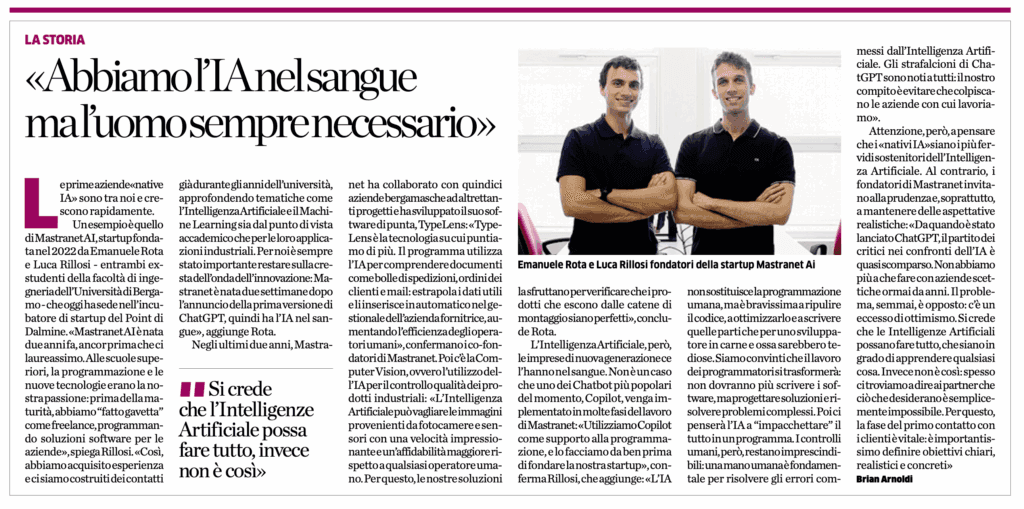
The article in L'Eco di Bergamo
Our thanks to Brian Arnoldi for covering our view on applying artificial intelligence in business for L'Eco di Bergamo, the daily newspaper of Bergamo. The headline - "We have AI in our blood, but humans are always necessary" - sums up our position fairly well: enthusiasm for the technology, no illusions about what it can do on its own.
The full clipping is at the bottom of this page. First, the passages that are most useful if you are evaluating us as a supplier.
A startup founded two weeks after ChatGPT
Mastranet AI was founded in 2022 by Emanuele Rota and Luca Rillosi, both former engineering students at the University of Bergamo. The company is based in the business incubator at the Point in Dalmine.
We met in high school, where programming and new technologies were already our shared interest: "Before graduating we had already cut our teeth as freelancers, writing software for companies," Rillosi recalls. "That is how we gained experience and built contacts during our university years, going deeper into artificial intelligence and machine learning both academically and in their industrial applications."
The detail behind the headline: the company was incorporated two weeks after the first version of ChatGPT was announced. "So it has AI in its blood," Rota adds.
Fifteen Bergamo companies behind TypeLens
Over the past few years we have worked with fifteen companies in the Bergamo area to build our software, TypeLens. That is not a minor detail: the product grew on real documents from real companies, not on a laboratory dataset.
"TypeLens is the technology we are betting most on. The software uses AI to understand documents such as delivery notes, customer orders and emails: it extracts the useful data and enters it automatically into the ERP, increasing the efficiency of the human operators."
If you want to understand the technology underneath, we explain it in detail in what OCR is and how it works and in delivery note automation.
Computer vision for quality control
The other strand is using AI for quality control on industrial products. "Artificial intelligence can sift through images coming from cameras and sensors at impressive speed and with greater reliability than any human operator. That is why our solutions use perception to verify that the products coming off the assembly line are perfect," Rota concludes.
AI does not replace the developer
We use Copilot to support our own development, and we did so well before founding the startup. But our position on the point is clear: "AI does not replace human programming. It is very good at cleaning up code, optimising it and writing the parts that would be tedious for a flesh-and-blood developer."
"We are convinced the developer's job will evolve: they will no longer write the software, they will design systems and solve complex problems. Human checks, however, remain essential: a human hand is fundamental to correcting the mistakes artificial intelligence makes. ChatGPT's blunders are well known to everyone, and our job is to keep them from hitting the companies we work with."
The problem is not scepticism, it is excess optimism
This is the passage from the interview that represents us best, and it is counter-intuitive: people who work with AI every day tend to be less enthusiastic than those watching from the outside.
"Since ChatGPT launched, the camp of AI critics has almost disappeared: we have not dealt with a sceptical company in years. If anything the problem is the opposite - there is an excess of optimism. People believe artificial intelligence can do anything, that it can learn anything. It cannot: we often find ourselves telling partners that what they want is simply impossible. That is why the first conversation with a client is vital: defining clear, realistic, concrete objectives matters enormously."
It is also why our first meeting with a company is not a demo but a conversation about which documents arrive, in what format, and what happens today when somebody opens them. If you want to have that conversation, get in touch: we will tell you frankly what can be automated and what cannot.
The full article
The clipping published in L'Eco di Bergamo, written by Brian Arnoldi: