
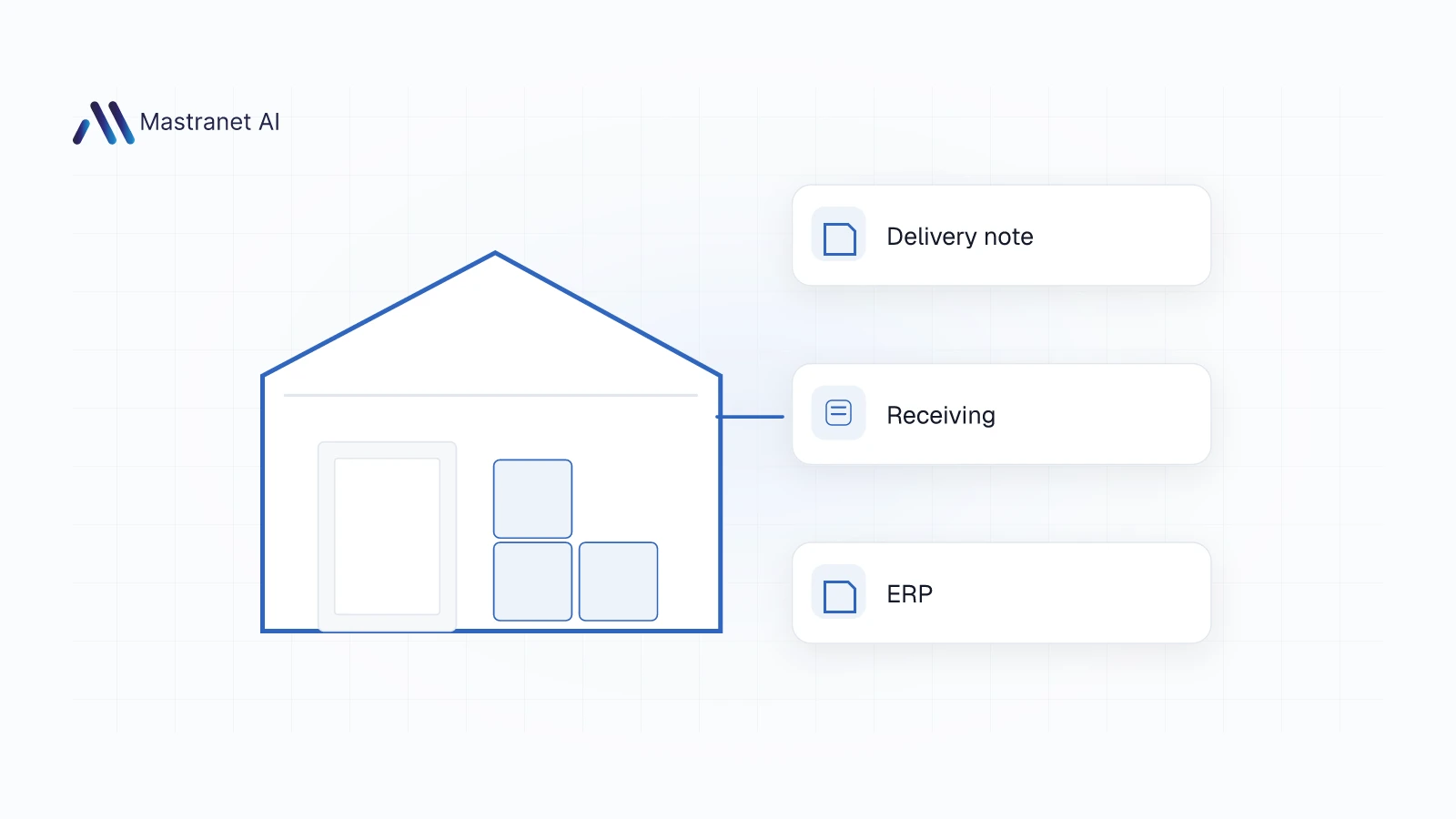
The Documento di Trasporto (DDT) is the transport document that has accompanied goods in Italy since 1996. Artificial intelligence now makes it possible to automate its creation, data extraction and ERP integration, removing manual data entry and cutting transcription errors by up to 95%.

What a DDT (transport document) is
Definition and legal basis (Presidential Decree 472/96)
The Documento di Trasporto (DDT) is a commercial document required by Italian law that travels with the goods and certifies their transfer from seller to buyer. Introduced by Presidential Decree 472/96 in place of the traditional bolla di accompagnamento, it serves both a tax and a civil-law function: it protects the goods in transit and acts as evidence in case of non-delivery or loss.
What a DDT is used for
A DDT documents the physical transfer of goods, justifies warehouse movements, forms the basis for issuing a deferred invoice, and proves delivery took place in the event of a dispute. In sectors such as construction it is also essential for tracking materials on site.
Mandatory information on a DDT
A DDT must contain:
- A sequential number and date of issue
- Sender details: company name, VAT number, address
- Recipient details: company name, delivery address
- Carrier details, if different from the sender
- Description, quantity and quality of the goods transported
- The unit of measure used
When issuing a DDT is mandatory
Issuing is mandatory in two main circumstances:
- Deferred invoicing: when the invoice is to be issued by the 15th of the month following delivery, rather than at the moment of shipment
- Movements without transfer of ownership: shipments that do not transfer title (goods on approval, subcontracting, returns, repairs)
How long a DDT must be kept (10 years)
A DDT must be kept for at least 10 years from the date of issue, by both the issuer and the recipient. Storage may be on paper or digital; digital storage must comply with Italian substitute-archiving rules (digital signature, timestamp, time reference enforceable against third parties).
Paper DDT vs digital DDT
| Aspect | Paper DDT | Digital DDT + automation |
|---|---|---|
| Entry time | 5-10 min per document | <1 min (validation) |
| Transcription errors | Frequent (1-3% of lines) | Minimal (<0.1%) |
| Operating cost | High (dedicated staff) | Low (supervision only) |
| Traceability | Low (physical archive) | Complete (digital log) |
| Compliance | Manual (risk of omissions) | Automatic (10-year retention) |
The limits of paper DDTs
Handling DDTs manually creates concrete, measurable problems. Manual entry is time-consuming and error-prone: wrong item codes block shipments, wrong amounts create billing problems. Operators spend hours retyping information that is already present in the documents they received.
The Politecnico di Milano figure
The Digital B2B Observatory at Politecnico di Milano calculated that only 35% of Italian companies issue digital DDTs and only 22% receive them. A general obligation to transmit them electronically could generate savings of 18 billion euros a year for the Italian production system - more than eight times national spending on cybersecurity.
How to automate DDT processing with AI
Intelligent Document Processing (IDP) for DDTs
Intelligent Document Processing is the technology that turns a paper DDT or an unstructured PDF into data ready for the ERP. Unlike traditional OCR, IDP understands the meaning of the fields - not just the text - and adapts to each supplier's variable layout without requiring manual templates.
The technologies that make up an IDP system for DDTs:
- Intelligent OCR: accurate transcription of the text from the image
- NLP (Natural Language Processing): understanding what each field means
- Computer Vision: analysis of the document's layout and visual structure
- Adaptive machine learning: continuous improvement in accuracy
The process in 5 stages
- Automatic intake: the DDT arrives by email (as a PDF or image attachment) or is uploaded manually into the system
- Extraction and understanding: the IDP system reads the document, identifies the key fields (DDT number, date, item codes, quantities, units of measure) and assigns a confidence score to each extracted field
- Human-in-the-Loop validation: low-confidence fields are shown to the operator for a quick review. One click validates hundreds of lines
- Reconciliation against the order: the extracted data is compared with the matching purchase order in the ERP, and discrepancies are flagged automatically
- ERP entry: validated data is written into the ERP, updating stock levels, warehouse movements and order status
Human-in-the-Loop: the quality control step
Human-in-the-Loop is not a limitation of the system, it is a design choice. For high-confidence DDTs - known layout, good quality - the flow is fully automatic. For ambiguous cases - a new supplier, a poor scan, an illegible field - the operator steps in only where needed, in a review that takes seconds rather than minutes.

Automatic data extraction from DDTs
Intelligent OCR
The intelligent OCR engine is the first layer of extraction. It converts the DDT image into text, handling tilt, variable scan quality and different fonts. In modern systems, accuracy on good-quality documents exceeds 99%.
Adaptive machine learning
The real advantage of IDP over classical OCR is its ability to adapt. Every supplier has their own DDT layout: the "quantity" field may sit in a different column, under a different label, in a different numeric format. Adaptive ML learns the specifics of each layout and improves accuracy over time, without manual templates.
Achievable accuracy
Typelens customers reach accuracy above 84% from the very first uses on good-quality documents, improving progressively through the Human-in-the-Loop feedback cycle. On standardised layouts - recurring suppliers with a fixed format - accuracy exceeds 95%.
ERP integration
ERP integration is the step that turns extraction into operational value. The data pulled from the DDT - document number, date, supplier code, items, quantities, units of measure - is synchronised with the ERP, updating in real time:
- The status of open purchase orders
- Warehouse stock levels
- Inbound and outbound movements
- The deferred invoicing queue
Typelens natively supports the main Italian ERPs:
DDT automation by industry
Construction
In construction the DDT has specific characteristics: units of measure vary by material (m², m³, kg, pieces), the destination is often a site account, and the materials change with every order. For a full guide to what makes construction DDTs different, see DDTs in the construction sector →
Logistics and transport
For logistics operators handling thousands of DDTs a day from dozens of different senders, automation is indispensable. IDP systems adapt to each sender's layout, making it possible to process volumes that would otherwise be unsustainable with limited staff.
Industrial production
In production, incoming supplier DDTs feed straight into the production plan. Automation updates material availability in real time, enabling more precise planning and reducing line stoppages caused by missing components.
Food distribution
Food and beverage has specific traceability requirements (batches, expiry dates) and needs stock levels updated quickly. IDP systems for DDTs in this sector also extract batch and expiry data, which is essential for food compliance.
Benefits of DDT automation: ROI and metrics
Data entry time down 80%
A manufacturing company processing 80,000 DDT lines a year, which previously spent 5 minutes handling a single DDT, cut that to 1 minute after implementing Typelens. The result: over 1,100 hours recovered per year, roughly 0.5 FTE, with estimated savings of 12,500 euros annually.
Fewer transcription errors
Manual transcription errors - wrong item codes, transposed quantities, incorrect units of measure - are a constant source of operational blockages. Automation brings the error rate below 0.1%, effectively eliminating discrepancies caused by retyping.
Traceability and compliance
Every processed DDT generates a structured, immutable log: date received, data extracted, validations performed, the operator who approved it, and the timestamp of ERP entry. That audit trail is valuable both for internal controls and for tax inspections.
How to get started: 3 steps
1. Assess volumes and formats
The first step is understanding the context: how many DDTs arrive each month, from how many different suppliers, in what formats (digital PDF, scanned PDF, image), and which fields are critical for your ERP. This analysis defines the scope of the pilot and the accuracy you should expect.
2. Pilot project
The pilot starts on a representative subset: typically the 2-3 suppliers with the highest volumes. Within 4-6 weeks you reach a measurable accuracy baseline, train the operational team, and validate the ERP integration logic.
3. Roll-out and ERP integration
Once the pilot is validated, roll-out extends the system to all suppliers and the full cycle. The ERP integration is consolidated with the company's specific mapping rules, and the workflows are tuned using the data gathered during the pilot.
Frequently asked questions about DDTs and automation
What is a DDT?
The DDT (Documento di Trasporto) is a mandatory commercial document introduced by Presidential Decree 472/96. It travels with the goods and certifies their transfer from seller to buyer.
When is issuing a DDT mandatory?
A DDT is mandatory for deferred invoicing (invoice issued by the 15th of the following month) and for movements of goods without transfer of ownership (goods on approval, subcontracting, returns, repairs).
Can a DDT be digital?
Yes. A DDT can be transmitted digitally as long as it is sent by the day the delivery begins. Electronic transmission is as legally valid as paper.
How long must a DDT be kept?
A DDT must be kept for at least 10 years from the date of issue, by both the issuer and the recipient, for tax and audit purposes.
How do you automate DDT processing?
Automation runs on IDP systems: the DDT arrives by email or upload, intelligent OCR extracts the data, Human-in-the-Loop validates it, and it is written automatically into the ERP.
What is the difference between a DDT and a bolla di accompagnamento?
The DDT replaced the bolla di accompagnamento under Presidential Decree 472/96. The old document was mandatory for almost all goods, while the DDT is required only in specific cases. In everyday use the two terms are often treated as synonyms.
Can DDTs be signed digitally?
Yes. Digital signatures are legally valid on DDTs. In many modern logistics chains the recipient signs digitally on delivery using a tablet, and the signed DDT is archived automatically.
Conclusions
Digitising and automating DDTs is no longer a future project: IDP technology is mature, ERP connectors are available, and the ROI is measurable within months. For companies handling hundreds or thousands of DDTs a month, automation is the only way to free people from manual entry and move them onto higher-value work.
The next step is understanding how intelligent OCR works underneath these systems, or how the MCP protocol enables AI agents that orchestrate the whole DDT-to-ERP flow autonomously.