
In a fast-moving market, AI-driven business process automation is now a strategic choice. It's not just about efficiency: it improves decision quality, increases operational reliability, and scales without exploding costs. The result: reduced cycle times, fewer errors, and teams focused on high-value activities.
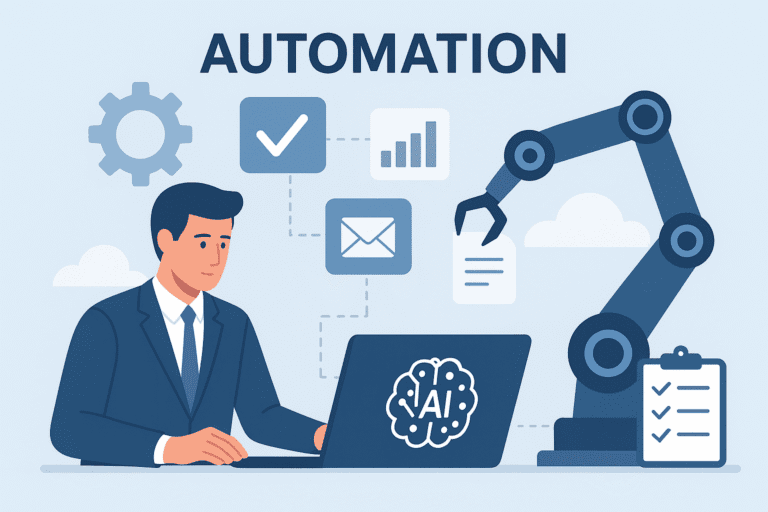
What AI Automation Really Means
Before diving into practical cases and discovering the benefits of AI in business processes, it's useful to clarify the scope. By automation with artificial intelligence, we mean the combined use of Machine Learning and GenAI models to execute, assist, or orchestrate activities that previously required human intervention.
Today's technology covers many fronts:
- Natural Language Processing (NLP) to understand texts, emails, and chats
- Computer Vision to interpret images or PDFs
- Predictive models to estimate demand, risks, or delivery times
- Optimization techniques to plan resources and inventory
- Decision intelligence to translate data into operational actions
The point is not to "replace" people, but to amplify their capabilities by reducing manual tasks and providing more informed suggestions or decisions.
Where Artificial Intelligence Generates Value
AI's impact is cross-functional and touches nearly every department. Here are some examples:
- Operations & Supply Chain: enables demand forecasting, shift and machine planning, anticipating failures through predictive maintenance, and optimizing inventory to reduce capital lockup.
- Sales & Marketing: helps produce brand-consistent content and calibrate pricing and promotions with greater precision.
- Customer Service: virtual assistants handle first contact, route tickets, and suggest responses to operators, improving both speed and quality.
- Finance & Controlling: AI accelerates forecasts and closings, detects anomalies in near real-time, and facilitates complex reconciliations.
- HR: benefits from faster CV screening, skill-to-role matching, and personalized training paths.
- IT & Security: models detect suspicious patterns, automate repetitive DevOps/ITSM tasks, and improve SLAs.
Benefits of AI in Business Processes: Measurable Strategic Advantages
The value of AI automation is measured in numbers.
Operational Efficiency
The first visible indicator is operational efficiency: shorter cycle times, faster case resolution, queues that clear up. Reducing the average time per case or document frees up capacity without adding headcount, with immediate benefits for customer experience and revenue.
Quality
A second pillar is quality. Fewer manual activities means fewer errors and less rework: AI validates fields, cross-references data, and flags inconsistencies before they become problems. The difference shows in rejection rates, punctuality, and report accuracy.
Decision-Making
Then there's the decision-making dimension. Predictive models and operational suggestions lead to faster, data-driven decisions, from inventory reordering to discount approvals, to prioritizing tickets and opportunities.
This is an advantage that grows over time, as models learn from new data and the information base expands.
Scalability
Scalability is the fourth axis: processes capable of absorbing peaks or growth without duplicating fixed costs. With an integrated architecture, reliable data, monitored models, and solid orchestration, the company also becomes more resilient, because it identifies bottlenecks and deviations in advance.
Employee Experience
Finally, an often-underestimated benefit: employee experience. Removing repetitive and ungratifying tasks reduces cognitive load, improves engagement, and frees up time for consulting or relational activities. More motivated teams produce better results and accelerate the adoption of transformation.
One of the Most In-Demand Applications: AI for Document Management and Data Entry
While AI is broad by nature, document management remains one of the most in-demand areas because it combines high volumes with clear rules.
Here, AI interprets PDFs and emails, extracts critical information, and feeds downstream systems without manual steps. The transformation doesn't just concern administration: it touches logistics, procurement, customer service, compliance, and every area that depends on timely and traceable data.
The advantage translates into shorter administrative times, drastically reduced errors, and end-to-end traceability. Achieving a high rate of processing without human intervention also means that the majority of documents "flow" on their own, while operators focus on the exceptions that truly matter.
The combined effect is increased productivity and operational peace of mind.
Beyond documents, many processes suffer from fragmented manual data entry. AI makes it possible to standardize data entry and synchronize systems reliably: the goal is not just to "copy" data, but to enrich, validate, and route it correctly. The result is an ERP that reflects the real state of the business without delays, with positive impacts on planning and customer service.
Building Faster and Smarter Processes: The Winning AI Path
Automating with AI means building faster, more accurate, and scalable processes, but above all smarter ones: processes that learn and improve with use.
If you want to start on the right foot, focus on high-volume processes with clear rules, define measurable KPIs from day one, and adopt a gradual approach: pilot, expansion, industrialization.