
Workflow Builder Automation
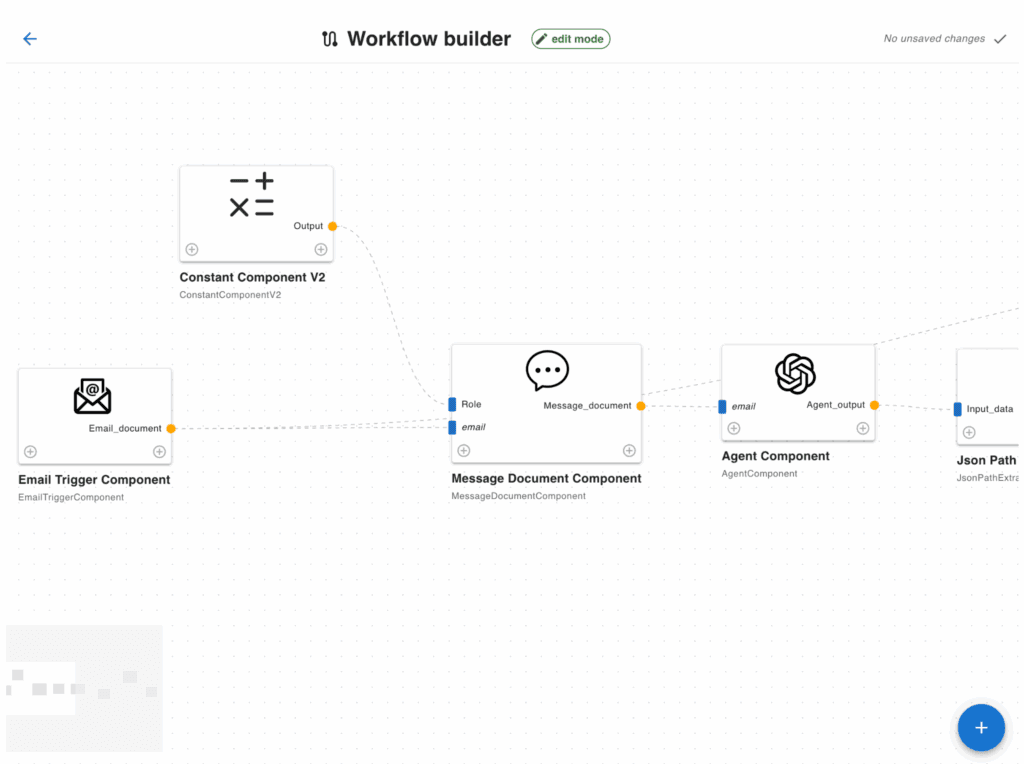
The evolution of artificial intelligence in the business world is reaching a decisive turning point. With the introduction of the new Workflow Automation Builder by Typelens, the Mastranet AI team has taken business process automation to an entirely new level, combining the power of AI agents with the simplicity of visual no-code building.
Self-Configurability, Advanced Customization, and Scalability
Modular Construction with Intelligent Blocks
The heart of the Workflow Builder lies in its self-configurability. Users can easily take pre-built blocks and customize them according to their specific needs. This modularity allows you to:
Adapt workflows to the unique requirements of every company
Reuse components across different processes
Scale rapidly by adding new functionalities
AI Agents: The Engine of Intelligent Automation
Agents represent the true added value of our system. These intelligent components do not merely execute predefined tasks — they apply specialized reasoning to make decisions and extract structured data from documents and emails. You can run multi-step workflows while ensuring compliance with business rules, with the ability to combine multiple workflows or run them in parallel.
Each agent can be configured for specific roles and orchestrated through a central router, enabling intelligent handoffs based on context, user input, or business logic. This orchestration of multiple agents makes it possible to tackle problems too complex for the capabilities of a single AI component.
Human In The Loop (HITL)
A major innovation introduced with the new version of Typelens is the addition of the "Human In The Loop" component. As the name suggests, it ensures human presence within the process. You can add this component when you want to validate data extracted from documents by the AI Agent.
This component can also be used to align with the business workflow: for example, a purchase order is received by the procurement office, and once validated by an employee (HITL), the data is passed to the production department to prepare the order or to the warehouse for shipping.
Advantages of No-Code Building
No-code building represents a true democratic revolution in business automation. The Workflow Automation Builder eliminates technical barriers, allowing team members from various departments to automate repetitive tasks, optimize operations, and improve productivity without relying on IT departments.
But that's not all! For more complex automations, some components allow greater customization through Python code by the IT department or directly by the Mastranet AI team.
Rapid and Iterative Implementation
The no-code approach offers tangible advantages in terms of implementation speed:
Rapid deployment: fast implementation and adaptation of workflows
Easy modification: intuitive drag-and-drop interfaces for workflow design
Pre-built templates: ready-to-use models for common workflow scenarios
Our Builder is simple enough to implement in hours, sophisticated enough to be scalable.
Integration and Connectivity with Business Processes
The system integrates seamlessly with the company's existing ecosystem, just as Typelens already does with the major ERPs on the market: SAP, Odoo, Zucchetti, etc. Enterprise integrations allow companies to transcend departmental boundaries with pre-built connections that promote standardized data exchange across multiple workflows.
Workflow automation ensures the maintenance of standard operating procedures, guaranteeing that every task is executed consistently and verified. This standardization eliminates the variations that can occur when different team members follow different approaches.
The Speed of Large Language Models
The real strength of the system lies in its ability to create different workflows for each company. This customization ensures a faster response time from large language models, since each LLM can be optimized for specific tasks and particular business contexts.
The intelligent orchestration of workflows allows you to make the most of large language model capabilities through:
Model specialization: each LLM can be fine-tuned for specific documents or particular business domains
Latency reduction: response time optimization through targeted and/or parallel workflows
Additional Advantages of the Workflow-Centric Approach
Implementing automated workflows leads to measurable benefits:
Increased efficiency: elimination of repetitive tasks and focus on high-value strategic initiatives
Error reduction: minimization of human errors, particularly in tasks such as data entry
Faster completion: significantly reduced processing times compared to manual processes
Business Scalability and Flexibility
Customized workflows allow companies to:
Handle growing workloads without compromising performance
Adapt dynamically to changes in business requirements
Integrate new processes easily into the existing system
Conclusion: The Future of Business Automation
The Workflow Automation Builder by Typelens represents the natural evolution of the Mastranet AI platform, combining the power of artificial intelligence with the ease of use that characterizes the best no-code solutions. Through the intelligent orchestration of specialized AI agents and the customization of workflows for each specific business need, this new feature promises to radically transform how companies manage their operational processes.
The ability to optimize large language model performance through targeted workflows, combined with the democratization of automation through no-code interfaces, positions Typelens at the forefront of innovation in the intelligent business automation sector.