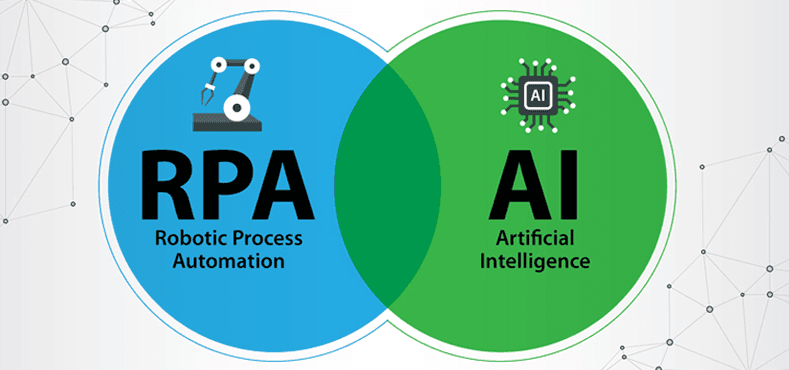
Treating RPA and artificial intelligence as competing products often leads to poor process design. RPA is suited to executing stable steps. AI is suited to interpreting variable information. An AI agent can decide which action to take, but it must operate within defined permissions, policies, and controls.
The useful question is therefore not simply RPA or AI?. The real questions are which parts of the process must remain deterministic, which parts require interpretation, and which actions can be delegated without increasing operational risk.
RPA, AI, and agents are different components
These terms are often used interchangeably, but they describe different responsibilities within an automation system.
RPA: repeatable execution
Robotic Process Automation reproduces a sequence of actions in existing applications. It can open a program, copy a value, complete a field, download a file, or start a procedure. Given the same input, it follows the same path.
It is effective when interfaces, rules, and data are stable. It becomes fragile when a screen changes, a field disappears, or the process encounters an unforeseen case.
AI: interpreting variable inputs
An AI component classifies, extracts, compares, or interprets information. It can recognise invoice data across variable layouts, understand the intent of an email, or map a free-form description to a master-data record. Its output should not be treated as implicit certainty. Controls must match the risk of the field and the action that follows.
AI agent: choosing actions
An AI agent receives an objective, uses the available context, and chooses among authorised tools. It might query the ERP, verify a purchase order, request missing information, and prepare a transaction. Its ability to select a path distinguishes it from a single extraction model and from an RPA robot.
The agent is not the complete process. Queues, states, timeouts, permissions, approvals, retries, and audit trails belong to the orchestration layer around it.
A matrix for choosing the architecture
The choice depends on four variables: input structure, rule stability, action risk, and integration quality. The table is a starting point, not a substitute for analysing the process.
| Situation | Primary component | Reason |
|---|---|---|
| Structured inputs and stable rules | API or RPA | The path can be described and verified deterministically. |
| Variable documents, emails, or descriptions | AI plus rules | Interpretation is needed, but the output must pass explicit checks. |
| Multiple systems and a context-dependent path | Agent plus orchestrator | The process must choose tools and steps based on case state. |
| Irreversible or high-impact action | Workflow with approval | AI can prepare the decision without necessarily executing it. |
| Legacy system without reliable APIs | RPA as an adapter | The robot connects the workflow to an interface that exposes no service. |
Four questions to ask first
Can the rules be written without ambiguity? If so, a deterministic component should remain central.
How much do the inputs vary? Layout, language, and completeness determine the need for interpretation.
What happens if the system is wrong? The cost of error defines thresholds, controls, and approvals.
How does it reach business systems? APIs, RPA, and protocols such as MCP have different maintenance and reliability profiles.
Why a hybrid workflow is often the right choice
In real processes, interpretation and execution rarely coincide. A sales order may arrive in free-form language, while its creation in the ERP must follow precise fields, authorisations, and rules. An invoice may require AI to read line items, while total validation must be deterministic.
A hybrid architecture separates responsibilities:
AI understands documents, language, and context;
business rules enforce constraints, tolerances, and mandatory checks;
an AI agent chooses the next step from an allowed set of actions;
APIs or RPA execute operations in business systems;
an orchestrator manages states, errors, retries, service levels, and approvals;
people handle exceptions and decisions that require accountability.
This separation avoids two extremes: asking RPA to interpret cases that cannot be encoded as rigid rules, and allowing a probabilistic model to perform operations that require repeatable outcomes.
Five levels of autonomy
A project does not have to choose between complete human control and complete autonomy. It is more useful to assign a delegation level to each action.
Level 1, assists. AI retrieves information, summarises the case, or highlights anomalies. A person performs every action.
Level 2, recommends. AI suggests a classification, match, or response, then waits for the operator’s decision.
Level 3, prepares. The system completes a transaction draft and gathers evidence without changing the system of record.
Level 4, executes with approval. The agent starts the action only after human review or an explicit authorisation policy.
Level 5, executes within defined limits. The system completes low-risk cases that pass thresholds and checks, while routing the others to an exception queue.
The same workflow can use different levels. It might automatically post an invoice that passes every check, then require approval when bank details change or a purchase-order reference is missing.
How to govern an AI agent
Governance is not a review to add after the prototype. It is part of the architecture and defines what the agent can see, decide, and execute.
Identity and least privilege
Every tool should apply role permissions and limit data and actions to what is necessary. An agent should not use shared credentials or gain broader access than the person or service for which it operates.
Policies that become controls
A statement such as “check that the invoice is correct” is not an operational policy. Define mandatory fields, tolerances, authoritative sources, blocking conditions, and the thresholds that require approval.
Audit trail and rationale
Each case should preserve its inputs, workflow version, consulted data, invoked tools, completed checks, decisions, approvals, and result. The log must explain the operational path, not merely store a model’s text response.
Fail safely
If a system is unavailable, data is inconsistent, or the agent lacks enough evidence, the workflow should stop, retry under control, or create an exception. Inventing the missing value is not a recovery strategy.
MCP and tool access
The Model Context Protocol can standardise how agents access data and tools. It does not replace authentication, authorisation, input validation, or logging. These controls remain the responsibility of the business architecture and the servers that expose operations.
Three practical use cases
1. Sales-order entry
AI interprets emails and attachments, then identifies the customer, products, quantities, and dates. Rules validate master data, codes, availability, and mandatory fields. An agent can ask for missing data or select the correct flow. APIs or RPA prepare the order in the ERP. If the customer cannot be matched or a commercial condition is unusual, the case goes to an operator.
2. Accounts payable and matching
The document component extracts header data and line items. The workflow retrieves the purchase order and receipt, applies two-way or three-way matching, and classifies discrepancies. Consistent cases can advance, while amount variations, duplicates, or new bank details require the assigned approval level. For the complete process, read our guide to accounts payable automation.
3. Operational email
AI classifies the message and retrieves context from authorised systems. The agent prepares a reply, opens a case, or assigns it to a team. Informational, low-risk communication can follow automatic rules. Complaints, contract changes, and ambiguous requests go through review. A dedicated article covers email automation with AI.
Common design mistakes
Automating the process as it is. The system makes inefficiency faster instead of removing it.
Using an agent for every step. Simple rules, calculations, and mandatory constraints remain more reliable when deterministic.
Confusing confidence with correctness. A model score does not replace checks on the result.
Treating exceptions as edge cases. Ownership, priority, and resolution time must be designed before go-live.
Granting excessive permissions. Prototype convenience can become operational risk.
Measuring only the model. The outcome matters when the complete process reaches the correct result.
How to design a pilot
A pilot should verify a real process using representative inputs, actual integrations, and success criteria defined before testing.
Set the process boundary. Identify its start, finish, systems, and expected outcome.
Classify the decisions. Separate deterministic rules, interpretations, and actions that require human accountability.
Assign the autonomy level. Define which cases can advance, which need confirmation, and which must stop.
Design the exceptions. Every deviation needs a category, owner, priority, and target resolution time.
Measure the operational result. Check correct outcome, cycle time, human interventions, downstream errors, and audit-trail quality.
If the pilot works only on cases selected for the demo, it has not verified the architecture. A useful test also includes incomplete inputs, unavailable systems, and conditions that must produce a safe refusal.
Frequently asked questions
What is the difference between RPA and an AI agent?
RPA executes a predefined sequence. An agent interprets context and selects permitted actions. They often work together: the agent chooses the path and RPA completes a step in a legacy system.
When should a company use RPA instead of AI?
When rules, inputs, and interfaces are stable and exceptions can be encoded. If the process must interpret language, documents, or variable situations, it needs an AI component within a controlled workflow.
What does intelligent automation mean?
It combines AI, rules, orchestration, APIs or RPA, and human control. Each component handles the responsibility for which it is best suited while the overall process remains verifiable.
Can an AI agent operate without human review?
Only for bounded actions governed by policy. High-impact operations require authorisation, traceability, and approval before execution when the risk demands it.
How do you choose between RPA, an AI agent, and a hybrid workflow?
Assess input variability, rule clarity, action risk, and available integrations. An end-to-end process often requires a combination rather than one tool.
Which metrics should an automation pilot use?
Correct outcome, cycle time, share of cases completed without intervention, exception time, downstream errors, and audit-trail quality. Model accuracy is only one part of the evaluation.
The decision is about architecture, not labels
RPA and AI agents are not two generations from which a company must choose once and for all. They are components with different properties. Reliable automation keeps mandatory controls deterministic, uses AI where interpretation is needed, and grants autonomy in proportion to risk.
Start with a bounded process, explicit rules, identified systems, and clear accountability. Only then does it make sense to select the tools.