
A Revolution in Manufacturing Industries
why
What Is Computer Vision?
In a constantly evolving sector like manufacturing, the efficiency of production processes and the quality of finished products are always at the center of attention. This is where Computer Vision comes in, a field of artificial intelligence that simulates the human ability to "see" and "interpret" the world and allows computers to obtain meaningful information from different visual inputs (digital images, videos, etc.). Computer vision is therefore revolutionizing quality control in manufacturing industries.
The Advantages of Computer Vision in Quality Control
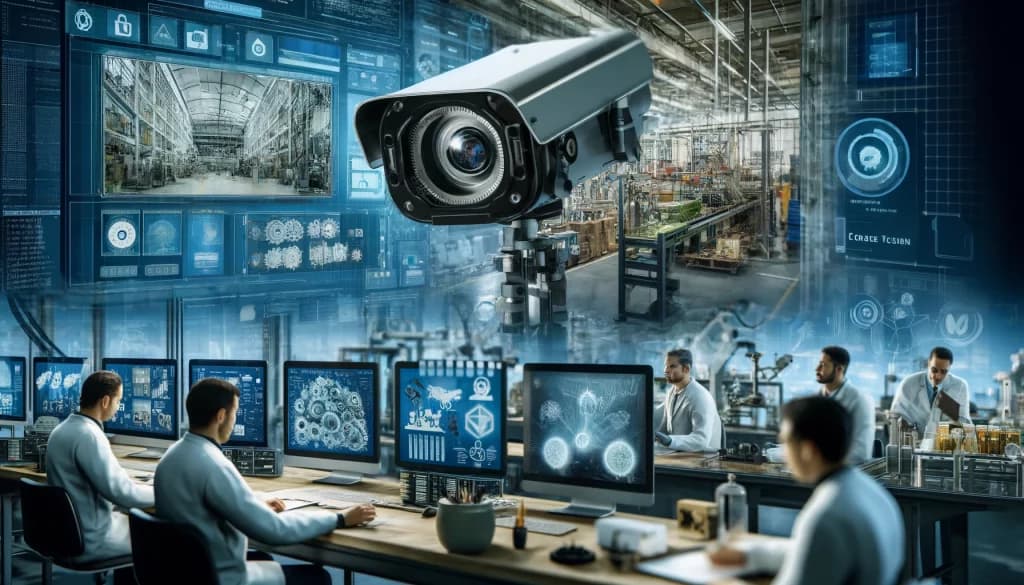
- Improved Precision: Computer vision systems can detect defects with precision and consistency superior to human capability, as they are not susceptible to distractions or fatigue.
- Inspection Speed: It enables real-time inspection, speeding up the quality control process and increasing productivity.
- Cost Reduction: It is possible to reduce costs associated with returns, repairs, and after-sales service, minimizing the number of defective products shipped to customers.
- Learning and Adaptability: Vision systems can adapt to new products or production variations without costly reprogramming, precisely thanks to their ability to learn and improve over time.
- Automation: Through a high degree of automation, Computer Vision reduces the need for human intervention and thus allows personnel to focus on value-added activities.
Mastranet AI's Computer Vision Technology
The innovation that Mastranet AI brings to the field of computer vision is the efficiency with which its systems can be trained. Traditionally, training a machine learning model requires a vast dataset of images to "teach" the system how to recognize defects. However, in the real world, a sufficient number of samples is not always available, especially when it comes to rare or unusual defects.
This is where Mastranet AI's technology comes in. Thanks to semi-supervised learning and transfer learning techniques, it only needs a few examples of healthy and unhealthy samples to begin its learning process. This means the system can become operational much more quickly and with less effort in terms of data collection.
Using a combination of advanced algorithms, Mastranet AI is able to generalize the concept from a small data set to recognize a wide range of defects, thus drastically reducing implementation time and cost.
Conclusions
In conclusion, Mastranet AI's Computer Vision technology offers the manufacturing sector unexplored potential for improving quality control. Lower costs, more efficient processes, and a significant competitive advantage are just some of the promises that Mastranet AI can deliver, offering cutting-edge solutions in the modern industrial landscape. For more information on how our company can transform your quality control, we invite you to visit our website or contact us directly for a demonstration of our technology.