
A typical Italian manufacturing SME - 80 to 300 employees, revenue between 25 and 200 million, an ERP installed ten or fifteen years ago, two or three technical people close to retirement, margins under pressure - hears about artificial intelligence everywhere: at industry conferences, from visiting consultants, from machine suppliers, in the Industry 4.0 plans that were sold as transformation and often ended up as a tax incentive and little else.
This guide does not promise to transform your company. It explains, in practical terms, where AI delivers real value in an Italian manufacturing SME, where it fails systematically, how to choose a starting point, and what to do in the first ninety days of a serious project. It is based on what we have seen work - and not work - in the projects Mastranet AI has run with Italian companies in this sector.
The honest starting point: why most AI projects in SMEs fail
Before talking about what works, it is worth saying what does not. From what we observe in Italian manufacturing, AI projects that fail in an SME share five recurring patterns. Recognising them is worth more than any catalogue of applications.
1. Starting from the technology, not from the bottleneck. The conversation typically opens with "we would like to introduce AI" or "our board is asking for an AI strategy" - not with "we have a specific operational problem costing us X euros a year". Without a concrete problem, any AI project becomes a solution looking for a need, and is forgotten within six months.
2. Confusing general-purpose AI with vertical AI. Handing an employee ChatGPT is not an AI strategy: it is a personal productivity tool. Fixing the customer order entry flow into the ERP is an AI strategy. The two have completely different costs, risks and ROI, but they are frequently conflated.
3. Underestimating integration with existing systems. Italian manufacturing SMEs run on Italian ERPs (TeamSystem, Zucchetti, Dynamics 365 Business Central, Sistemi, Ad Hoc), legacy MES and dedicated WMS. Any AI project that does not integrate with those systems stays an island. The question "how does it talk to the ERP?" belongs in the first meeting with the supplier, not six months later.
4. Overestimating the maturity of your own data. Vendors talk about "the AI learns from your data" as if the data were ready. Often it is not: item master data with unmapped alternative codes, disorganised manuals, unstructured machine logs, technical knowledge living in the head of someone about to retire. An AI project in an SME almost always surfaces - and often has to solve - a foundational problem that predates the AI.
5. No internal owner with decision-making authority. Without someone in the company (Operations Director, IT Manager, COO, or the owner in family businesses) who owns the project, defends it in front of others and has a mandate to change processes, the project stalls on the first objection from anyone. The problem is not technological, it is organisational.
With those five patterns in mind, we can talk about the positive side.
The 7 areas where AI actually works in an Italian manufacturing SME
Not all areas of AI are equally mature for an SME. Some are ready products you can switch on in weeks; others are multi-year projects with uncertain outcomes. Here is the practical taxonomy, ordered by value-to-effort ratio for a typical Italian manufacturing SME.
| Area | What it does | Maturity for SMEs | Typical go-live | ROI horizon |
|---|---|---|---|---|
| 1. Document automation | Extracts data from email, PDFs and scans and writes it into the ERP | High | 3-4 weeks | 6-12 months |
| 2. Knowledge management and troubleshooting | Turns manuals and technical know-how into an assistant for operators | High | 4-8 weeks | 6-12 months |
| 3. Visual quality control | Computer vision for identifying defects on the line | Medium-high | 2-4 months | 12-18 months |
| 4. Customer support and B2B portals | Technical and commercial chatbot over catalogue and products | Medium-high | 1-3 months | 6-12 months |
| 5. Predictive maintenance | Failure prediction from sensor data | Medium | 6-12 months | 18-36 months |
| 6. Production optimisation and scheduling | Production planning optimised against real constraints | Low-medium | 6-18 months | 24-48 months |
| 7. Custom solutions for a specific process | AI built around a use case unique to the company | Variable | 3-9 months | 12-24 months |
The first two areas - document automation and knowledge management - are where most companies should start: they are the most mature, the fastest to implement, they have ROI you can calculate before you begin, and they carry low technology risk. The last two - advanced scheduling and custom work - can produce extraordinary results, but they require a level of organisational maturity that most SMEs only reach after cutting their teeth on simpler applications.
1. Document automation (orders, delivery notes, invoices, certificates)
This is the most mature and most underrated use case. A typical manufacturing SME receives dozens or hundreds of commercial documents every day - customer orders by email, supplier delivery notes, purchase invoices to register, CE certifications and declarations of conformity for purchased materials. All of them contain information that has to be typed into the ERP, checked and filed. A back office team generally spends between 30% and 60% of its time on that repetitive work.
Modern document AI - different from the template-based OCR many companies have already tried without success - reads the document, understands the content in the context of the company's catalogue, matches it to internal codes and writes the data straight into the ERP. The operator only validates the exceptions.
2. Knowledge management and industrial troubleshooting
In an Italian manufacturing SME, a large share of technical knowledge lives in the heads of a few people: the experienced maintenance technician who knows "where to tap" when a machine stops, the production manager who remembers why a batch was halted three years ago, the engineer who wrote the restart procedure after the manufacturer's last visit. That knowledge is often unwritten, scattered across PDFs on network folders, paper notes and years-old emails.
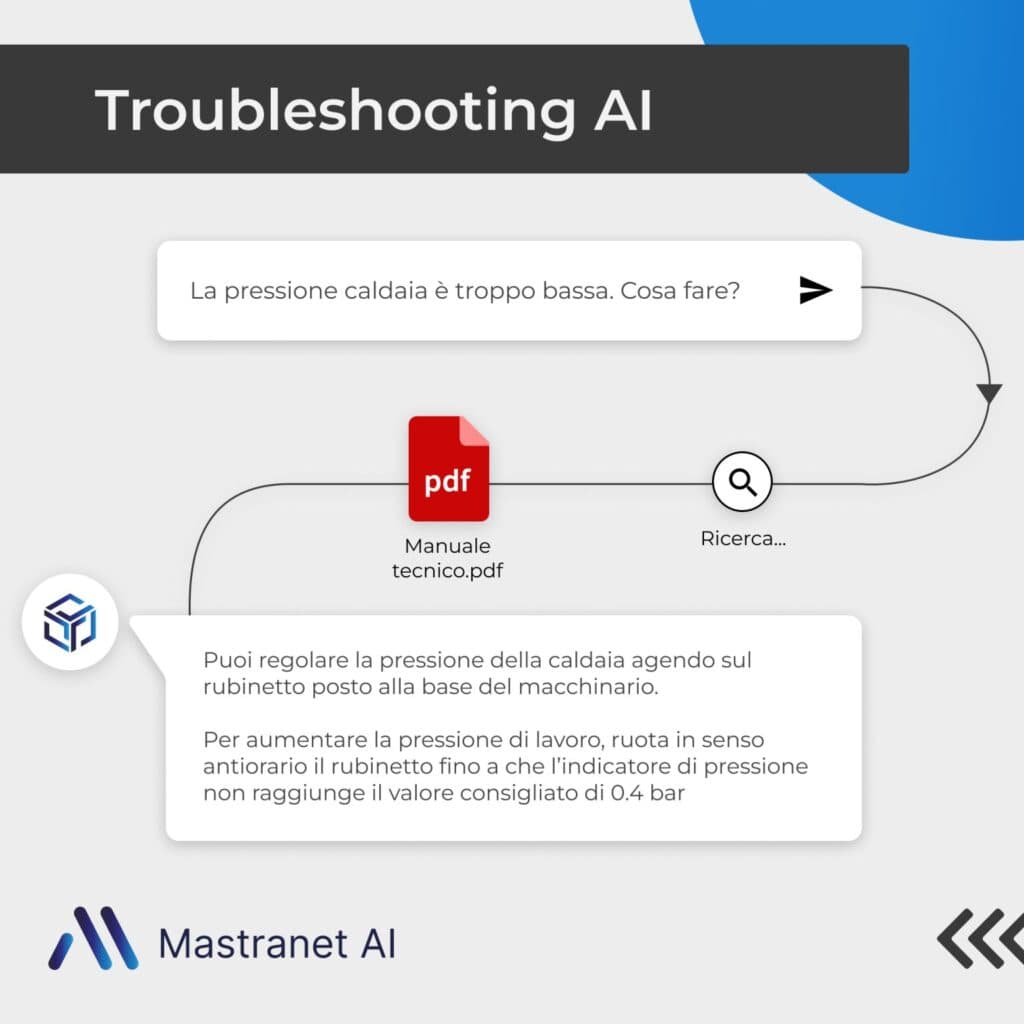
A vertical AI assistant for industrial maintenance takes all of it - manufacturer manuals, internal procedures, historical service logs, FAQs - and turns it into an assistant reachable from a tablet or phone at the machine. The operator asks "machine X is showing error 47, what does that mean?" and gets the right answer in seconds, with precise references to the manual.
3. Visual quality control
Industrial computer vision is a mature technology, in many cases older than the current wave of generative AI. For a manufacturing SME with a measurable quality problem - surface defects on metal parts, contamination on a food line, assembly errors - there are ready solutions that can be installed within months. The constraint is not the technology: it is having labelled samples to train the system, and integrating it physically into the production line.
4. Customer support and intelligent B2B portals
For SMEs with a wide product catalogue and a B2B customer base, a technical and commercial chatbot trained properly on the catalogue significantly reduces repetitive requests to customer service. It works when the catalogue is structured and the knowledge base is maintained. It works less well when the product requires genuine technical consultancy, where AI can only act as a first filter.
5. Predictive maintenance
The promise of Industry 4.0 since the days of super-depreciation incentives. The honest truth: it works where sensors are already installed, where there is a meaningful data history (at least 12-24 months), and where there is a recurring, reasonably predictable failure mode. For many Italian manufacturing SMEs the sensor prerequisite is not yet met, and the sensible first investment is a plant one - installing the sensors - not an AI one.
6. Production optimisation and scheduling
Optimising production planning with AI is one of the most interesting - and most complex - areas. It requires a structured MES, well-modelled business constraints, and deep integration with the ERP and the warehouse. Done well, it frees up production capacity without buying additional machinery. Done badly, it is one of the fastest ways to lose hundreds of thousands of euros in consultancy.
7. Custom solutions
Every SME has at least one unique process that no standard software covers. Real examples: the calibration system for a type of industrial valve, automatic quotation generation from complex technical specifications, thermographic image analysis for a particular material, classification of electronic components from heterogeneous datasheets. These are the areas where custom AI - built with a partner - can create a defensible competitive advantage, because the problem solved is specific to the company and cannot be replicated by a competitor buying off-the-shelf software.
Three real cases from Italian companies
Three concrete examples of the patterns described above. Each illustrates a different way of adopting AI in a manufacturing SME.
Case 1 - NTE Process: document routing for certifications and datasheets
NTE Process works in industrial plant engineering and automation. Every day it receives hundreds of technical documents from suppliers - CE certifications, declarations of conformity, datasheets for purchased materials. Handling them manually meant a team dedicated to classifying them, extracting the relevant data and filing them in an organised way. An apparently trivial activity that absorbed qualified time and created delays downstream.
Implementing TypeLens - Mastranet's AI document automation software - made it possible to automate the routing of incoming documents, extract the relevant information automatically (batch, supplier, material reference, applicable standard) and file it in a structured way. The case earned NTE Process an honourable mention at the PMI Award 2025 run by the Digital Innovation Observatory of Politecnico di Milano.
Pattern: a high-volume document use case, ROI calculable in months, integration with existing systems, low technology risk.
Case 2 - Complex manufacturing: knowledge management and troubleshooting
A second recurring pattern in our projects involves manufacturers with complex machinery and maintenance teams working across heterogeneous types of equipment. In those companies every machine stoppage triggers a hunt for information: where is the manual? What did the service procedure say? What did a colleague do the last time this error came up?
MIRA - Industrial Troubleshooting Suite addresses exactly that: it takes the company's entire technical knowledge base (manufacturer manuals, internal procedures, service logs, FAQs) and turns it into a virtual assistant queried in natural language, reachable from a tablet or smartphone at the machine. The operator no longer searches - they ask, and get contextual answers with precise references to the documentation.
Pattern: the value is not "automating a task", it is "making accessible the knowledge that already exists but is fragmented". For companies with technical staff turnover or approaching retirement, it is one of the most strategic patterns.
Case 3 - A custom solution for a specific process
In other projects the company's problem fits no standard product. Examples we have worked on at Mastranet: automatic extraction of technical parameters from heterogeneous electronic component datasheets for a specialist distributor; product image analysis for a non-standard quality check; a semantic matching system between customer specifications and multi-supplier catalogues.
In these cases no ready vertical SaaS exists: the problem is specific to the company, but it is also the problem that - solved well - becomes a defensible advantage over competitors. The approach is project-based: start from an analysis of the operational flow, build a proof-of-concept, integrate it with existing systems, measure the result.
Pattern: longer timelines (3-9 months), higher investment, but competitive value that cannot be replicated by buying a licence.
A decision framework: choosing where to start
Faced with seven possible areas and three ways of adopting them, there is only one practical question: where do we start?
The framework we use with Mastranet clients is five questions, taken in order.
Question 1 - Which bottleneck costs us the most?
Not "where do we want to use AI", but "where do we lose the most time, money and customers?". The answer is usually prosaic: order entry time, fulfilment errors, machine downtime, slow responses to customer technical questions. That is where you start. Every AI area listed above begins with a concrete problem, not an abstract aspiration.
Question 2 - Does the necessary data or knowledge exist?
For each candidate AI project, check:
- For document automation: do I have a historical archive of documents of the same type? Is my item master data clean?
- For knowledge management: does the technical knowledge exist in written form anywhere? In manuals, procedures, service tickets?
- For predictive maintenance: do I have sensors? Do I have at least 12-18 months of operating data?
- For visual quality control: do I have a sample of conforming and defective parts to start from?
If the answer is no, the first investment is not AI - it is creating the prerequisite.
Question 3 - Is there a ready vertical product, or do we need custom?
There are three ways an SME adopts AI:
Ready vertical SaaS (TypeLens for documents, MIRA for troubleshooting, visual quality control from specialist vendors). These switch on in weeks, have predictable ROI and low risk. Use them when the problem fits a standard category.
General-purpose tools adopted internally (ChatGPT Enterprise, Copilot, Claude for office work). These serve knowledge workers' personal productivity, not process automation. They should be evaluated separately from a strategic AI project.
Custom development with a partner (AI solutions designed around the company's specific process). Longer timelines, higher investment, but defensible value. Choose this when the problem is unique - and that uniqueness is precisely what turns the solution into competitive value.
For most SMEs, the first AI project is better as a vertical SaaS: fast ROI, low risk, and the organisation learns how an AI project is run. Custom work goes better afterwards, once there is internal experience.
Question 4 - What is the expected ROI, and how will we measure it?
Before starting any AI project, fix:
- Which number has to change (order fulfilment time, errors, machine downtime hours, customer satisfaction measured as NPS or response time)
- What that change is worth (euros per year)
- When we expect to see it (month 3, month 6, month 12)
Without those three numbers the project is not a project: it is an experiment with no success criterion. The most important thing we ask a client before starting is exactly this quantification.
Question 5 - Who is the internal owner?
An AI project needs someone inside the company with three characteristics: (a) they understand the process being automated, (b) they have the authority to change it, (c) they have time to follow the project. Often it is the Operations Director, sometimes the IT Manager, sometimes the owner in a family business. Without that person the project stalls on the first unresolved detail.
What does not work: five anti-patterns
From what we see in projects we manage to rescue mid-flight - and in those we cannot save - the most common failures have predictable causes.
Starting from the technology vendor rather than your own problem. If the first conversation is with an AI platform supplier before you have mapped your own bottlenecks, the near-certain outcome is a solution in search of a problem.
Chasing the trend of the moment. In recent years: first generic chatbots, then RPA, then custom machine learning, then LLMs, then agentic AI. Every 18 months the name of what you are supposed to be doing changes. The SMEs that built real value are the ones that ignored the trend and focused on their own operational problem.
Mistaking an individual tool for a company strategy. Handing out ChatGPT licences to the team is not an AI strategy. It is an individual productivity decision - useful, but it changes no business process and removes no structural cost.
Underestimating ERP integration. Italian ERPs - TeamSystem, Zucchetti, Dynamics, Sistemi, Ad Hoc - are the company's nervous system. An AI project that does not integrate natively with your ERP stays an island with data duplicated by hand. The question "how does it talk to our ERP?" belongs on the first slide of the evaluation, not the last.
Not planning for change management. Even the best AI software fails if the people who should use it do not. Communicating why, training, supporting, gathering feedback in the first weeks of operation: it is the least technological part, and it is what separates a shelved project from one in production.
Getting started: a 90-day operating plan
For an Italian manufacturing SME that wants a serious first AI project, a realistic plan in three phases.
Days 1-30 - Diagnosis
- Internal workshop with area managers (Operations, IT, Customer Service, Production, Finance) to map the 3-5 most expensive operational bottlenecks
- Quantify each one (person-hours, errors, direct costs, opportunity costs)
- Check data and system prerequisites (master data, historical archives, ERP integration)
- Select one single pilot use case - the one with the best value-to-effort ratio, not the most ambitious one
- Define the success KPIs and the internal owner
Days 31-60 - Pilot
- Choose the approach (vertical SaaS, custom, general-purpose) that fits the chosen case
- Onboard the product or start the custom project
- Configure and train on the company's real data
- Set up the integration with existing systems
- Run in parallel with the manual process, for validation
Days 61-90 - Measurement and the scaling decision
- Compare expected KPIs against measured KPIs
- Decide: scale to the rest of the organisation, or stop and keep the learnings
- If scaling: plan the roll-out and identify the second candidate use case
Three months is enough for an honest first verdict. Projects that propose "let's review in a year" with no intermediate milestones very rarely reach production.
Three closing rules
Start from a small, measurable case, not a general strategy. An SME that has properly automated customer order entry has a real case, a team that has learned how an AI project runs, and foundations for the second project. An SME with a "group AI strategy" and nothing in production has slides.
Choose partners who understand the Italian context. Italian ERPs, Italian documents (DDT, XML e-invoices, certified email), Italian regulation, Italian SME dynamics. A global vendor that is excellent on technology but only integrates enterprise SAP and only understands American invoicing will create practical problems you will struggle to see before signing.
Do not buy AI: buy a solved problem. Successful SMEs did not purchase AI. They solved a specific problem - order entry, document routing, machine troubleshooting - using AI as the tool. The distinction sounds rhetorical, but it changes everything: how you evaluate suppliers, what the KPIs are, who the owner is, and how the project is communicated internally.
Frequently asked questions
When does it make sense for an Italian manufacturing SME to adopt AI?
When there is a concrete operational bottleneck that can be quantified in time or money, and when the necessary data or knowledge base exists or can be created. Not when "everyone is talking about it" or "the board is asking". The honest starting point is always a measured problem, not a strategic aspiration.
Which use case should you start from?
In most Italian manufacturing SMEs the two most sensible starting points are document automation (customer orders, delivery notes, invoices, certifications) and knowledge management for maintenance. They have high calculable ROI, low technology risk, and the first project in production builds the internal skills for more ambitious ones.
How much does an AI project cost in a manufacturing SME?
It depends on the approach. A vertical SaaS such as TypeLens or MIRA follows a subscription model sized on volume, with a limited upfront investment and ROI typically within 6-12 months. A custom project runs from 30,000 to 200,000 euros depending on complexity, with development taking 3 to 9 months. General-purpose tools such as ChatGPT Enterprise have per-user costs closer to an Office licence.
How long does it take to see results?
For a vertical SaaS project the first evidence arrives within the first weeks of operation; ROI is typically measured within 6-12 months. For a custom project the first results come after the pilot is released (3-6 months), with ROI in 12-24 months.
Do you need dedicated internal people for an AI project?
Not full time, but you do need an internal owner with decision-making authority who can give the project a few hours a week for its duration. Without that person, no supplier - however good - can get the project into production.
Will AI replace back office staff?
In our experience no, but it changes the work. Repetitive typing drops sharply; exception handling, supplier management, customer support and business development grow. For an SME struggling to find qualified staff - the structural problem of Italian manufacturing - that redistribution is generally welcomed by the teams themselves.
How does AI integrate with our existing ERP?
It depends on the ERP and the AI product chosen. Mastranet products (TypeLens and MIRA) integrate natively with TeamSystem, Zucchetti, Microsoft Dynamics 365 Business Central and Odoo, and connect via REST API to custom systems or legacy ERPs. The question "how does it talk to my ERP?" should be asked explicitly, and answered with precise technical detail.
Does the data stay inside the company?
For cloud SaaS products, data is hosted on European infrastructure with GDPR compliance and end-to-end encryption. For stricter requirements (regulated sectors, particularly sensitive data), on-premise installations or dedicated environments are available. On this point it is worth asking the supplier for precise technical documentation before signing.
How do you tell a serious AI supplier from a superficial one?
Three decisive questions: (a) show us a real production case from an Italian company similar to ours, (b) describe how you integrate with our specific ERP, (c) how will we measure the project's success, and over what period. A supplier who answers those three in generalities, however elegant the pitch, is not yet ready to deliver you a result.
What does Mastranet AI do in this space?
Mastranet AI is an Italian scale-up based in Dalmine (Bergamo) building AI software for Italian companies in three ways: TypeLens, a SaaS product for document automation; MIRA, a SaaS product for knowledge management and industrial troubleshooting; and bespoke AI projects for company-specific problems. Our customer base includes manufacturers and industrial distributors across Italy.
In summary
For an Italian manufacturing SME seriously evaluating how to apply artificial intelligence to its processes, three things to keep in mind:
- Start from the problem, not the technology. Mapping the operational bottleneck that costs the most is the prerequisite for any serious AI project.
- Pick the most mature use case for the first project. Document automation and knowledge management are the two areas where an Italian SME builds value fastest and with least risk.
- Insist on integration, measurable ROI and an internal owner. Those are the three factors separating projects that reach production from projects that stay in slides.
For a practical conversation about your case - which bottlenecks you have, where it makes sense to start, in what form - write to us at mastranet.ai/en/contact-us.